3CO04 Essentials of People Practice introduces the basics of people practice. It covers the employee lifecycle, workplace policies, and key rules and laws. It also looks at important areas like recruitment, talent management, reward, and learning and development—skills that are essential for a career in people practice.
Task One: Recruitment and Selection
AC 1.1 Create a diagram that shows stages in the employee lifecycle. After reading all the tasks in the assessment brief, annotate each stage to explain how people professionals at Jemijo could contribute to the stages in your diagram.
The employee lifecycle is a model that describes the key stages an individual passes through during their relationship with an organisation, from initial attraction through to eventual separation. Understanding this lifecycle enables people professionals to design interventions that optimise the employee experience at every stage, thereby enhancing organisational performance, engagement, and retention (CIPD, 2024a). Figure 1 below presents an annotated lifecycle diagram showing how people professionals at Jemijo could contribute to each stage.
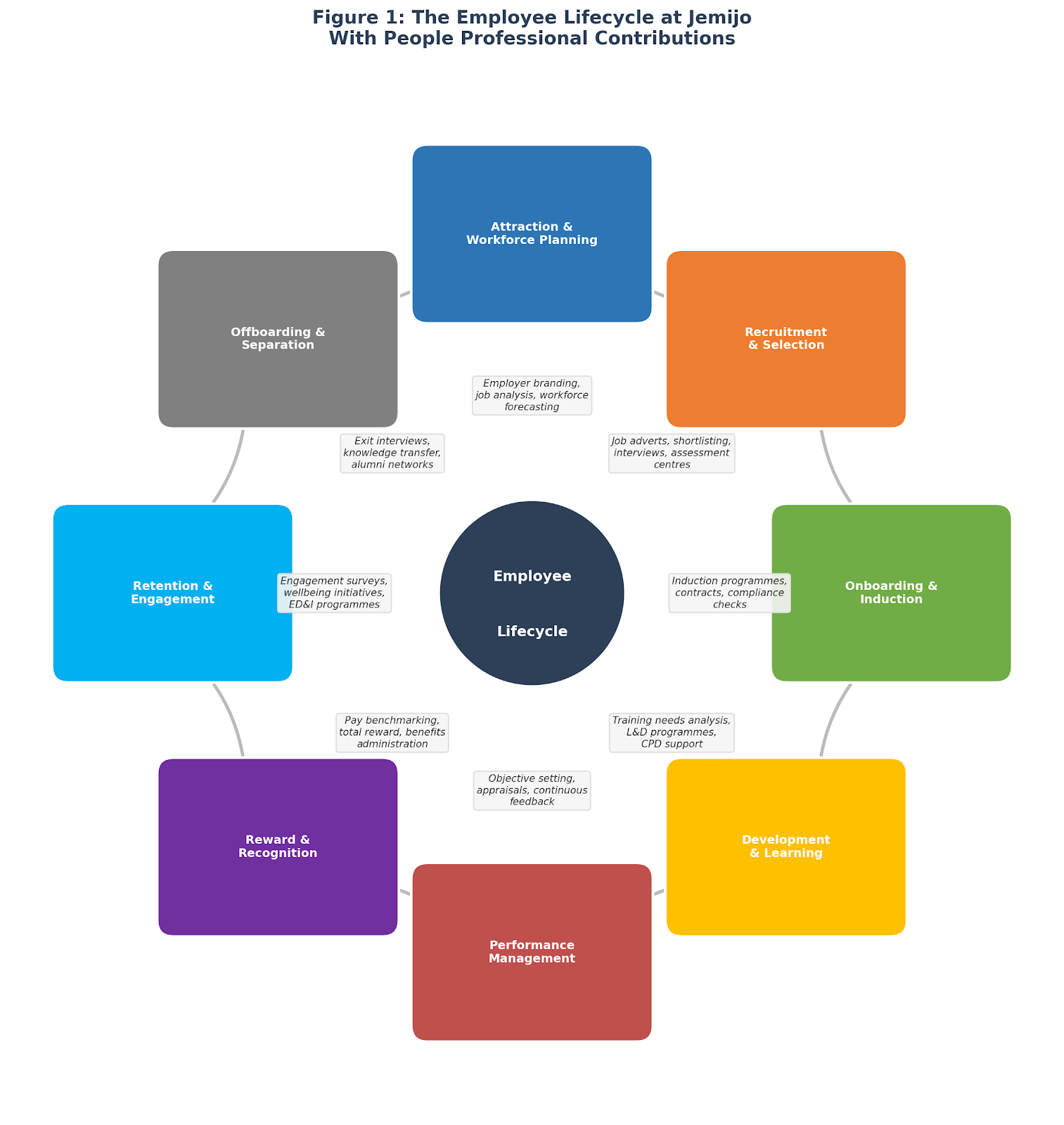
At the attraction and workforce planning stage, people professionals at Jemijo contribute by developing an appealing employer brand, conducting workforce planning to forecast staffing needs for the 24/7 claims hotline, and conducting job analysis to ensure role requirements are accurately defined. During recruitment and selection, the people team drafts compelling job advertisements, manages applications through the company website and external job boards, designs structured interviews and assessment centres, and ensures shortlisting processes are fair and legally compliant (Taylor, 2022).
At the onboarding and induction stage, people professionals prepare contracts of employment, coordinate the six-week basic training programme for new call centre staff, and ensure all compliance documentation is completed. During the development and learning phase, the team identifies training needs beyond the basic programme, designs learning interventions, and supports continuous professional development. In the performance management stage, people professionals support objective-setting, facilitate appraisal processes, and advise managers on performance improvement approaches (Armstrong and Taylor, 2023).
During the reward and recognition stage, people professionals design and administer total reward packages, ensure pay equity, and manage benefits. At the retention and engagement stage, the team conducts engagement surveys, designs wellbeing initiatives, and implements diversity and inclusion programmes. Finally, at the offboarding and separation stage, people professionals conduct exit interviews, manage knowledge transfer, ensure compliance with notice periods and final pay calculations, and maintain alumni relationships where appropriate.
AC 1.2 Explain how job analysis can help to create an accurate job description and person specification, for the role of a claims handler, at Jemijo’s call centre
Job analysis is a systematic process of collecting, documenting, and analysing information about a job’s tasks, responsibilities, required competencies, working conditions, and reporting relationships (CIPD, 2024b). It serves as the foundation upon which accurate job descriptions and person specifications are constructed, ensuring that both documents reflect the genuine requirements of the role rather than outdated assumptions or managerial preferences.
For the claims handler role at Jemijo’s call centre, job analysis would involve gathering information through multiple methods. These could include observing current claims handlers as they process telephone and digital insurance claims, conducting structured interviews with experienced claims handlers and their supervisors to identify the core tasks and challenges of the role, reviewing existing process documentation and call-handling scripts, and analysing performance data to determine which behaviours and competencies distinguish high-performing claims handlers from average performers (Torrington et al., 2024).
The data gathered through job analysis directly informs the creation of the job description, which is a factual document that outlines the role’s purpose, key duties, reporting lines, and working conditions. For the claims handler role, job analysis might reveal that the role requires handling an average of 40 inbound calls per shift, processing claims across multiple insurance product lines, using specialist claims management software, escalating complex or disputed claims to senior handlers, and working rotating shifts including weekends and bank holidays. Without rigorous job analysis, the job description might omit critical duties or include tasks that the role no longer involves, leading to mismatched expectations for both the employer and the applicant.
Equally, job analysis informs the person specification, which details the qualifications, skills, experience, and attributes required to perform the role competently. Through analysing the claims handler role, Jemijo’s people professionals might determine that essential criteria include strong verbal communication skills, the ability to remain calm under pressure when dealing with distressed claimants, numerical accuracy for processing financial information, and proficiency with CRM systems. Desirable criteria might include previous experience in insurance or financial services and a Level 2 qualification in customer service. Importantly, job analysis ensures that each criterion in the person specification can be objectively justified as genuinely necessary for the role, which is critical for defending recruitment decisions against potential discrimination claims under the Equality Act 2010 (Lewis and Sargeant, 2023).
AC 1.3 Jemijo advertise vacancies though their website and on commercial jobs boards. Explain each of these recruitment methods and explain why these methods are appropriate for advertising call centre vacancies.
Company Website
Advertising vacancies through Jemijo’s company website involves hosting a dedicated careers section that lists current openings, provides information about the organisation’s culture and benefits, and enables candidates to apply directly. This is a form of direct recruitment that gives Jemijo full control over its employer branding, the content and presentation of job advertisements, and the candidate journey from initial interest to application submission (CIPD, 2024c).
This method is appropriate for call centre vacancies because it allows Jemijo to showcase the specific benefits of working in its call centre environment, such as training opportunities, career progression pathways, and the company’s values. It also attracts candidates who have already demonstrated an interest in Jemijo by actively visiting the website, which may indicate higher levels of organisational fit and motivation. Furthermore, website-based recruitment is cost-effective, as there are no per-advertisement fees once the infrastructure is in place, making it particularly efficient for high-volume recruitment typical of call centre environments (Taylor, 2022).
Commercial Job Boards
Commercial job boards, such as Indeed, Reed, and Totaljobs, are third-party online platforms that aggregate job advertisements from multiple employers, allowing job seekers to search for vacancies by keyword, location, salary, and sector. Employers pay either per-listing fees or subscription charges to advertise roles on these platforms, which benefit from very high traffic volumes and sophisticated search functionality (CIPD, 2024c).
Commercial job boards are appropriate for Jemijo’s call centre vacancies because they dramatically extend the reach of the advertisement beyond individuals who already know of Jemijo. Given that call centre roles are often filled by candidates who search generically for customer service or telephone-based work rather than for a specific employer, job boards are essential for capturing this wider applicant pool. They also enable Jemijo to target specific demographics and geographies through filtering options and sponsored placement features. For high-volume roles where attracting a large number of applicants is critical, job boards provide the necessary scale and visibility that a company website alone cannot achieve.
AC 1.4 Explain why the content of the copy used in the job adverts on Jemijo’s website could vary compared to the content of copy on commercial jobs boards.
The content of the copy used in job adverts on Jemijo’s website could, and arguably should, vary compared to the copy on commercial job boards because the two platforms serve different audiences, operate within different contextual environments, and are subject to different practical constraints.
On Jemijo’s own website, the job advert can be more detailed and immersive because it exists within a branded environment where the candidate already has access to information about the company’s history, values, culture, and other roles. The website copy can therefore focus on the specific role details, team culture, day-to-day responsibilities, and career development opportunities without needing to re-establish who Jemijo is. The advert can use richer multimedia content, such as employee testimonials, video introductions from team managers, and detailed benefit breakdowns, because the platform supports this without character or format restrictions (Rees and French, 2022).
By contrast, commercial job board copy typically needs to be more concise, punchy, and self-contained. Candidates browsing job boards are scanning multiple vacancies simultaneously, so the advert must capture attention quickly and communicate the essential information, including role title, salary range, location, and key requirements, within the first few lines. Most job boards impose character limits or charge more for longer listings, which necessitates brevity. The copy on job boards also needs to include more contextual information about Jemijo as an employer, since candidates may never have heard of the organisation and do not have the surrounding website content to provide context. Additionally, job board copy should be optimised for search algorithms, incorporating relevant keywords such as ‘customer service’, ‘call centre’, ‘insurance claims’, and ‘shift work’ to ensure the advertisement appears in relevant search results (CIPD, 2024c).
Furthermore, the tone may differ. Website copy can reflect a more conversational, employer-branded tone that conveys organisational personality, while job board copy often benefits from a more structured, information-led approach that prioritises clarity and searchability. However, both versions must remain consistent in their factual content regarding the role’s requirements, salary, and terms to avoid misleading candidates or creating legal risk.
AC 2.1 Explain why structured interviews and assessment centres are appropriate selection methods for call centre roles at Jemijo.
Structured Interviews
Structured interviews involve asking all candidates the same predetermined questions, in the same order, with responses evaluated against a standardised scoring framework. This contrasts with unstructured interviews, where questions vary between candidates and assessment is largely subjective. Research consistently demonstrates that structured interviews have significantly higher predictive validity than unstructured formats, meaning they are better at predicting subsequent job performance (Sackett et al., 2022).
Structured interviews are particularly appropriate for call centre roles at Jemijo because the claims handler position requires a defined set of competencies, including communication skills, empathy, problem-solving, and resilience, that can be systematically assessed through carefully designed competency-based and situational questions. For example, interviewers could ask candidates to describe a time they handled a frustrated customer, or to explain how they would respond to a claimant reporting a distressing incident. The standardised scoring criteria ensure that all candidates are assessed fairly and consistently, which is essential for legal compliance with the Equality Act 2010 and for defending selection decisions if challenged (Taylor, 2022).
Assessment Centres
Assessment centres are multi-method selection events that combine several exercises, such as role-plays, group discussions, in-tray exercises, presentations, and psychometric tests, to evaluate candidates against the requirements of the role. They are typically assessed by multiple assessors using standardised criteria, providing a more comprehensive and reliable picture of each candidate’s capabilities than any single selection method alone (CIPD, 2024d).
Assessment centres are appropriate for call centre roles at Jemijo because they allow candidates to demonstrate their abilities in realistic scenarios that closely simulate the demands of the role. A telephone role-play exercise, for instance, could require candidates to handle a simulated claims call from an upset customer, enabling assessors to evaluate communication skills, empathy, listening ability, and resilience under pressure in real time. Group exercises can assess teamwork and collaboration, which are important in a call centre where staff frequently share information and support each other. The multi-method approach of assessment centres also reduces the risk of assessment bias, as candidates have multiple opportunities to demonstrate their strengths across different exercises, and assessors can triangulate their judgements from multiple data points (Torrington et al., 2024).
AC 2.4 Explain what records from the structured interviews and assessment centres at Jemijo should be retained.
Jemijo should retain comprehensive and accurate records from the structured interviews and assessment centres conducted during the selection process. The records that should be retained include the following.
First, all application forms, CVs, and covering letters submitted by candidates should be retained, as these form the basis against which shortlisting decisions were made. Second, the completed shortlisting matrices showing how each applicant was scored against the selection criteria should be preserved, including the names of those who conducted the shortlisting and any notes explaining scoring decisions. Third, the structured interview scoring sheets for every interviewed candidate must be retained, documenting the questions asked, the candidate’s responses in summary form, and the numerical scores awarded against each competency. Fourth, assessment centre evaluation forms for each exercise, including role-play observation sheets, group exercise assessments, and any psychometric test results, should be kept. Fifth, the overall selection decision rationale, including the panel’s comparative assessment of candidates and the reasons for appointing the successful candidate and not appointing others, should be documented (CIPD, 2024d).
The retention of these records serves several critical purposes. Under the UK GDPR and Data Protection Act 2018, Jemijo must retain selection records for a lawful purpose and for no longer than necessary. The CIPD (2024e) recommends retaining recruitment records for a minimum of six months following the conclusion of the recruitment process, as this covers the three-month limitation period, plus a reasonable extension, within which an unsuccessful candidate could bring an employment tribunal claim for discrimination. Some organisations choose to retain records for up to twelve months as a precautionary measure. Accurate records enable Jemijo to demonstrate that selection decisions were made on the basis of objective, job-related criteria, providing a robust defence against any allegation of unlawful discrimination. Additionally, records support organisational learning by enabling the people team to review the effectiveness of selection methods and identify areas for improvement (Lewis and Sargeant, 2023).
AC 2.5 Using an AI tool of your choice, create templates for a letter of appointment and a letter of non-appointment for the call centre customer service role. Once you have created the templates, critically review each template, and explain which elements you would keep and why, and which elements you would remove or change and why.
The following templates were generated using an AI tool and have been critically reviewed for accuracy, legal compliance, and professional appropriateness.
Letter of Appointment: Critical Review
An AI-generated letter of appointment typically includes elements such as a congratulatory opening, the job title, start date, salary, reporting line, working hours, location, a brief mention of terms and conditions, and a request for the candidate to confirm acceptance. Having reviewed the AI output, the following elements would be retained and the following would be modified.
Elements to retain: The inclusion of the job title, start date, salary, and working hours is essential and should be retained, as these are among the written particulars that must be provided to employees under Section 1 of the Employment Rights Act 1996, as amended. The request for the candidate to confirm acceptance in writing is also important for establishing a clear contractual commitment. The warm, congratulatory tone of the opening is appropriate and should be retained, as it sets a positive foundation for the employment relationship and reinforces the employer brand.
Elements to change or add: The AI-generated template omitted several critical elements. First, a reference to pre-employment conditions, such as satisfactory DBS checks, right-to-work verification, and reference checks, should be added, as the offer should be clearly stated as conditional upon these being completed. This is particularly important for Jemijo given its insurance sector regulatory obligations. Second, the template lacked a reference to the probationary period, which should be specified, including its duration and the notice period applicable during probation. Third, the template should reference the full written statement of employment particulars that will follow or accompany the letter, as the appointment letter alone may not satisfy the employer’s statutory obligations under the Employment Rights Act 1996. Fourth, the template should include the date by which the candidate must respond, to enable Jemijo to manage its recruitment timeline effectively. Finally, generic or overly effusive AI-generated language should be replaced with Jemijo’s own organisational tone to ensure authenticity (CIPD, 2024e).
Letter of Non-Appointment: Critical Review
An AI-generated rejection letter typically includes a thank-you for the candidate’s application, confirmation that they have not been successful, a brief positive comment about the strength of the field, and an invitation to apply for future vacancies.
Elements to retain: The respectful and professional tone should be retained, as every candidate interaction reflects on Jemijo’s employer brand. The expression of gratitude for the candidate’s time and interest is appropriate and should remain. The encouragement to apply for future vacancies is also valuable, particularly for call centre roles where Jemijo regularly recruits, as it maintains a positive talent pipeline.
Elements to change or add: The AI template was too generic and impersonal, failing to acknowledge the specific stage at which the candidate was unsuccessful. The letter should specify whether the candidate was unsuccessful at the shortlisting, interview, or assessment centre stage, as this provides useful closure and transparency. The template also lacked an offer to provide feedback, which is considered good practice by the CIPD (2024d) and can significantly enhance the candidate experience, even for those not appointed. Additionally, the template should include information about how the candidate’s data will be handled post-decision, in compliance with the UK GDPR, specifying the retention period and the candidate’s right to request deletion. Finally, any AI-generated platitudes or clichés should be replaced with authentic, empathetic language that reflects Jemijo’s values.
Task Two: Selection Process
AC 2.2 Devise selection criteria for the post of People Assistant using the job description already written (Appendix A). Use the selection shortlisting matrix (Appendix B) to shortlist applications against the selection criteria to determine candidates to be interviewed. You must use the completed, sample application forms provided in Appendix C
Based on the People Assistant job description provided in Appendix A, the following selection criteria have been devised to enable consistent and fair shortlisting of applicants. The criteria are divided into essential and desirable categories, ensuring that all shortlisting decisions are based on objective, job-related requirements that can be evidenced from the application forms.
| Selection Criterion | Type | Assessment Method | Justification |
| CIPD Level 3 qualification or equivalent | Essential | Application form | Foundation-level HR knowledge required |
| Experience of providing HR administrative support | Essential | Application form | Core function of the role |
| Strong written and verbal communication skills | Essential | Application / Interview | Daily stakeholder interaction |
| Proficiency with HR information systems | Essential | Application form | Systems used daily for data entry |
| Knowledge of employment legislation fundamentals | Essential | Application / Interview | Ensures compliant advice |
| Ability to handle confidential information with discretion | Essential | Application / Interview | HR data sensitivity requires this |
| Experience in the insurance or financial services sector | Desirable | Application form | Sector understanding beneficial |
| CIPD Level 5 qualification or working towards | Desirable | Application form | Indicates commitment to CPD |
The shortlisting matrix (Appendix B) was completed by scoring each candidate’s application form against the above criteria using a standardised rating scale. Candidates who met all essential criteria were progressed to interview, while those who failed to evidence one or more essential criteria were not shortlisted. This approach ensures objectivity, consistency, and legal defensibility in the shortlisting process (CIPD, 2024d).
AC 2.3 Interview one applicant and decide whether they meet the criteria for the post. The interview could be a panel of no more than three learners from the same centre, or one-to-one interview (as determined by your centre). The interview could be conducted face-to-face or by web conferencing (as determined by your centre).
The interview was conducted using a structured competency-based format, with all questions and scoring criteria agreed in advance to ensure fairness and consistency. The interview panel comprised two interviewers, and the interview was conducted face-to-face. The candidate was assessed against the essential and desirable criteria listed above, with responses scored on a scale of 1 (no evidence) to 5 (strong evidence with specific examples).
The interview questions covered the following competency areas: understanding of HR administrative processes, knowledge of employment legislation, communication and interpersonal skills, ability to handle confidential information, and commitment to professional development. Each question was accompanied by follow-up probes to elicit specific examples from the candidate’s experience, consistent with the STAR technique (Situation, Task, Action, Result).
Following the interview, the panel independently completed their scoring sheets before comparing assessments and reaching a consensus decision. The panel’s deliberations focused on the evidence presented by the candidate against each criterion, ensuring that the decision was based on demonstrable competence rather than subjective impressions. Detailed notes were recorded throughout the interview and a written rationale for the final decision was documented, in accordance with best practice guidance on maintaining auditable selection records (CIPD, 2024d).
Task Three: Legislation and Employment Relations
AC 3.1 Explain, with reference to legislation, why it is important that call centre staff at Jemijo, working on the 24/7 claims hotline, have adequate periods of rest between periods of work and do not work excessive hours.
The Working Time Regulations 1998, which implement the EU Working Time Directive into UK law, establish legally mandated minimum rest periods and maximum working hours that are directly applicable to Jemijo’s call centre staff operating the 24/7 claims hotline. These regulations exist to protect workers’ health, safety, and wellbeing by preventing excessive fatigue and the associated risks of impaired performance, errors, and occupational illness.
Regulation 4 provides that a worker’s average working time, including overtime, must not exceed 48 hours per week, calculated over a standard 17-week reference period. While workers may voluntarily opt out of this limit in writing, Jemijo must ensure that any such opt-outs are genuinely voluntary and that the employee understands their right to withdraw consent with reasonable notice. Regulation 10 entitles workers to a daily rest period of at least 11 consecutive hours between each working day, while Regulation 11 provides for a weekly rest period of at least 24 uninterrupted hours in each seven-day period, or alternatively 48 hours in each fourteen-day period. Regulation 12 further requires that where a worker’s daily working time exceeds six hours, they are entitled to a rest break of at least 20 minutes, taken away from their workstation (HMSO, 1998).
For Jemijo’s 24/7 claims hotline, these provisions are particularly critical. Shift workers who rotate between day, evening, and night shifts are especially vulnerable to fatigue-related risks if rest periods are not properly managed. The Health and Safety Executive (HSE, 2023) has established clear evidence that sustained excessive working hours and inadequate rest periods are associated with increased rates of musculoskeletal disorders, cardiovascular problems, mental health deterioration, and workplace accidents. In a call centre context, fatigued employees are more likely to make errors in claims processing, provide poor-quality customer service, and experience stress-related absence, all of which carry significant operational and financial costs for Jemijo.
Non-compliance with the Working Time Regulations can expose Jemijo to enforcement action by the Health and Safety Executive, employment tribunal claims from affected workers, and reputational damage. Furthermore, as an insurance provider, Jemijo is subject to regulatory oversight by the Financial Conduct Authority, which expects firms to treat customers fairly. Employing exhausted staff to handle complex insurance claims is arguably inconsistent with this obligation, creating regulatory as well as employment law risks (Lewis and Sargeant, 2023).
AC 3.2 Briefly explain what is meant by the term wellbeing and explain why wellbeing is important in Jemijo’s call centre.
Wellbeing is a broad concept that encompasses an individual’s physical, mental, emotional, and social health, as well as their sense of purpose, financial security, and overall life satisfaction. The CIPD (2024f) defines employee wellbeing as creating an environment to promote a state of contentment which allows employees to flourish and achieve their full potential for the benefit of themselves and the organisation. Wellbeing extends beyond the absence of illness to encompass positive experiences of work, including feeling valued, supported, and able to manage the demands of the role without undue stress.
Wellbeing is particularly important in Jemijo’s call centre environment for several interconnected reasons. Call centre work is widely recognised as one of the most psychologically demanding occupational categories, characterised by repetitive tasks, high call volumes, continuous performance monitoring, emotional labour involved in managing distressed claimants, and limited autonomy over pace and content of work (Holman, 2023). These factors create a heightened risk of stress, burnout, and mental health deterioration among call centre employees.
The business case for investing in wellbeing at Jemijo is compelling. Research by Deloitte (2022) found that for every one pound invested in workplace mental health interventions, employers received an average return of five pounds through reduced absence, lower turnover, and increased productivity. For Jemijo, where high absence and turnover rates are common challenges in the call centre sector, a comprehensive wellbeing strategy can deliver measurable financial returns while simultaneously fulfilling the organisation’s ethical obligations to its workforce. Furthermore, employees who feel supported in their wellbeing are more likely to deliver the empathetic, patient, and professional service that Jemijo’s insurance claimants expect and deserve.
AC 3.3 Henry, a call centre manager at Jemijo, is keen to attract and select young people to work in the call centre and suggests advertising vacancies for 18- to 21-year-olds. With reference to discrimination legislation, summarise why this approach presents a legal risk.
Henry’s suggestion to advertise vacancies specifically for 18- to 21-year-olds presents a significant legal risk under the Equality Act 2010. Age is one of the nine protected characteristics defined in Section 4 of the Act, and Section 13 provides that a person discriminates against another if, because of a protected characteristic, they treat that person less favourably than they would treat others. Restricting job advertisements to a specific age group constitutes direct age discrimination because it explicitly excludes individuals outside that age range from applying, treating them less favourably on the grounds of their age.
Section 39 of the Equality Act 2010 specifically prohibits discrimination in the arrangements an employer makes for deciding to whom to offer employment, which includes the content and targeting of job advertisements. An advertisement that states vacancies are for 18- to 21-year-olds would constitute such unlawful arrangements, regardless of whether the underlying motivation is benign. Henry’s desire to attract young people, while understandable from a workforce planning perspective, does not provide a lawful justification for excluding other age groups (Lewis and Sargeant, 2023).
While the Equality Act 2010 does permit the use of a proportionate means of achieving a legitimate aim as a defence to indirect discrimination, this defence is extremely difficult to sustain in the context of direct discrimination, and it is almost inconceivable that restricting recruitment to 18- to 21-year-olds could be justified for general call centre roles. There is no occupational requirement related to age for processing insurance claims by telephone. The CIPD (2024g) advises that job advertisements should focus on skills, competencies, and behaviours rather than demographic characteristics, and that any criteria that disproportionately affect particular age groups should be reviewed for objective justification.
A safer and legally compliant approach would be for Jemijo to target its advertising through channels popular with younger demographics, such as social media platforms, university careers services, and apprenticeship schemes, while keeping the advertisement itself open to all age groups. This attracts younger applicants without unlawfully excluding others.
AC 3.4 Explain how the terms diversity and inclusion differ and why diversity and inclusion are important in Jemijo’s call centres.
While often used interchangeably, diversity and inclusion are distinct but complementary concepts. Diversity refers to the presence of differences within a given setting, encompassing the full range of human differences including, but not limited to, the protected characteristics defined by the Equality Act 2010 such as age, disability, gender reassignment, race, religion, sex, and sexual orientation. In a workplace context, diversity describes the demographic and experiential composition of the workforce, recognising that individuals bring different perspectives, backgrounds, skills, and identities to the organisation (CIPD, 2024g).
Inclusion, by contrast, refers to the practices, behaviours, and cultural norms that ensure every individual feels valued, respected, and able to contribute fully, regardless of their differences. Inclusion is about the quality of the experience that diverse individuals have within the workplace. An organisation can be demographically diverse but not genuinely inclusive if certain groups feel marginalised, undervalued, or unable to participate fully in decision-making, career development, or social interactions. As Kandola (2023) argues, diversity is a fact of demographics, while inclusion is a choice of culture.
In Jemijo’s call centres, diversity and inclusion are important for multiple reasons. A diverse workforce brings a wider range of perspectives, language skills, and cultural competencies, which enhances the quality of customer service provided to Jemijo’s diverse customer base. Insurance claimants come from every demographic background, and a workforce that reflects this diversity is better able to understand, empathise with, and respond to the needs of different customer groups. Research by McKinsey (2023) continues to demonstrate that organisations with greater ethnic and gender diversity consistently outperform less diverse peers on profitability, innovation, and employee engagement metrics.
Inclusion ensures that the benefits of diversity are realised in practice. Without an inclusive culture, diverse employees are more likely to experience exclusion, disengagement, and voluntary turnover, meaning that the investment in diverse recruitment is wasted. In a call centre context, inclusive practices include ensuring that shift patterns accommodate diverse needs, such as religious observance or caring responsibilities, that team meetings are conducted in a way that encourages contributions from all voices, and that performance management and promotion decisions are demonstrably free from bias.
AC 3.5 Henry advises you that Megan, a Jemijo employee with five years’ continuous service, swore at a customer who was frustrated about the time taken to deal with their insurance claim. Henry informs you that he has not taken any action yet but will dismiss Megan in a meeting today and asks whether there is a form that they need to fill out for this to ensure Megan is not overpaid. You are relieved that Henry has contacted you, but you are concerned about his proposal and the legal risk of his approach
Explain why Henry’s approach is likely to be viewed as an unfair dismissal and how the approach differs to the approach needed for a fair dismissal.
Henry’s proposed approach of dismissing Megan immediately in a meeting today, without any prior process, is very likely to constitute an unfair dismissal under the Employment Rights Act 1996. Megan’s five years’ continuous service means she has full statutory protection against unfair dismissal, as the qualifying period is two years’ continuous employment.
Why Henry’s Approach Is Likely Unfair
Henry’s approach is procedurally deficient in several critical respects. First, there has been no investigation into the incident. A fair dismissal requires the employer to conduct a reasonable investigation to establish the facts of the alleged misconduct before taking any disciplinary action. Henry has not interviewed Megan to hear her account of events, has not gathered evidence such as call recordings or witness statements, and has not considered any mitigating circumstances, such as whether the customer was abusive, whether Megan was under extreme workload pressure, or whether she has an unblemished disciplinary record over her five years of service.
Second, Henry has not followed a formal disciplinary procedure. The ACAS Code of Practice on Disciplinary and Grievance Procedures (ACAS, 2024), while not legally binding, is taken into account by employment tribunals when assessing fairness. The ACAS Code requires that the employer investigate the allegation, informs the employee in writing of the allegation and invites them to a disciplinary hearing with reasonable notice, holds a hearing at which the employee has the right to be accompanied, considers the evidence and any mitigating factors before making a decision, and provides the employee with a right of appeal against any disciplinary sanction.
Third, Henry appears to have predetermined the outcome. He has already decided to dismiss Megan before any meeting has taken place, which fundamentally undermines the fairness of the process. A fair disciplinary hearing requires that the decision-maker approaches the hearing with an open mind, having genuinely considered the employee’s response to the allegation.
Fourth, swearing at a customer, while serious, would not typically be classified as gross misconduct warranting summary dismissal unless the organisation’s disciplinary policy explicitly categorises it as such and the circumstances are sufficiently serious. Given Megan’s five years’ unblemished service, a first instance of verbal misconduct would more commonly warrant a formal warning rather than dismissal, unless there are aggravating factors that a proper investigation would reveal (Taylor, 2022).
The Approach Needed for a Fair Dismissal
For a dismissal to be fair, Section 98 of the Employment Rights Act 1996 requires that the employer demonstrates a potentially fair reason for dismissal, which in this case would be conduct, and that the employer acted reasonably in treating that reason as sufficient for dismissal. Reasonableness is assessed by reference to the band of reasonable responses available to a reasonable employer, taking into account the size and administrative resources of the organisation.
The process for a fair dismissal in this case would involve suspending Megan on full pay if necessary, while conducting a thorough investigation; gathering evidence including call recordings, customer testimony, and any relevant contextual information; writing to Megan formally, setting out the allegation and the evidence, and inviting her to a disciplinary hearing with at least 48 hours’ notice; informing Megan of her right to be accompanied by a trade union representative or work colleague; conducting the hearing, at which Megan has the opportunity to respond to the allegation, present her own evidence, and raise mitigating factors; adjourning to consider the evidence and reaching a balanced decision; communicating the decision in writing, with reasons; and providing Megan with a clear right of appeal, including details of how and to whom she should appeal (ACAS, 2024).
The people team should advise Henry that proceeding with his proposed approach would very likely result in a successful unfair dismissal claim by Megan at an employment tribunal, potentially resulting in a basic award, a compensatory award, and an uplift of up to 25% for failure to follow the ACAS Code. The reputational and financial costs of such a claim far outweigh the effort required to follow a fair and lawful procedure.
Task Four: Performance Management and Reward
AC 4.1 The CIPD factsheet, ‘Performance management: an introduction’, states that performance management includes the following activities:
- Establish objectives
- Improve performance
- Hold people to account
Explain how these activities could assist in the performance management of call centre staff at Jemijo.
Establishing Objectives
Establishing clear, measurable objectives is the foundation of effective performance management. For Jemijo’s call centre staff, objectives might include handling a minimum number of calls per shift, achieving a customer satisfaction score above a specified threshold, maintaining accurate records for a defined percentage of claims processed, and completing mandatory compliance training within specified timeframes. Well-crafted objectives provide employees with clarity about what is expected, enable managers to assess performance against transparent benchmarks, and align individual effort with organisational goals. The CIPD (2024h) recommends that objectives should be SMART (specific, measurable, achievable, relevant, and time-bound) and should be set collaboratively between the manager and employee to promote ownership and commitment. For call centre staff, collaborative objective-setting can increase engagement by giving employees a voice in shaping expectations rather than feeling subject to top-down targets that may feel arbitrary or unrealistic.
Improving Performance
Performance management is not merely about measuring output but actively supporting employees to improve. For call centre staff at Jemijo, this could involve identifying underperformance through call monitoring and quality audits, providing constructive feedback through one-to-one coaching conversations, arranging targeted training to address specific skill gaps such as handling complex claims or managing difficult conversations, and implementing performance improvement plans for employees who consistently fall below expected standards. The CIPD (2024h) emphasises that improving performance should be a supportive and developmental process rather than a purely punitive one. Managers should diagnose the root causes of underperformance, which may include inadequate training, unclear expectations, personal difficulties, or systemic issues such as insufficient staffing, before determining the most appropriate intervention. This diagnostic approach ensures that performance improvement efforts address genuine causes rather than symptoms.
Holding People to Account
Accountability ensures that employees understand the consequences of their performance and that high performance is recognised while persistent underperformance is addressed. For Jemijo’s call centre staff, accountability mechanisms could include regular performance reviews against agreed objectives, transparent use of performance data such as call handling times and customer feedback scores, recognition and reward for consistently high performers, and proportionate consequences for those who fail to meet standards despite adequate support. Holding people to account should be balanced with fairness and proportionality. Armstrong and Taylor (2023) argue that effective accountability requires managers to be consistent in their expectations and responses, avoiding favouritism or inconsistency that would undermine the credibility of the performance management system. In a call centre environment where performance metrics are highly visible, consistent accountability helps to maintain team morale and a culture of high performance.
AC 4.2 Explain how the level of skill and level of motivation of call centre staff at Jemijo could impact their performance.
The performance of call centre staff at Jemijo is influenced by the interaction between their level of skill and their level of motivation, both of which must be present for optimal performance to occur.
Skill refers to the knowledge, competencies, and abilities that an employee possesses and can apply to their work. For call centre staff, relevant skills include product knowledge of Jemijo’s insurance policies, technical proficiency with claims management software, communication skills for managing customer interactions, and regulatory knowledge to ensure compliance. An employee with high motivation but low skill will be enthusiastic but unable to perform effectively, potentially making errors in claims processing or providing incorrect information to customers. Conversely, a highly skilled employee who lacks motivation may perform at a technically adequate level but fail to deliver the empathetic, engaged customer service that differentiates Jemijo from competitors.
This interaction between skill and motivation is captured in several performance models. Boxall and Purcell’s (2022) AMO framework proposes that performance is a function of Ability (skills and knowledge), Motivation (the willingness to perform), and Opportunity (the organisational context and support structures). For Jemijo’s call centre, this means that performance management must address all three dimensions: developing skills through training, sustaining motivation through recognition, meaningful work, and fair reward, and providing the opportunity to perform through adequate resources, manageable workloads, and supportive management. Where performance issues arise, managers should diagnose whether the root cause is skill-related, motivation-related, or context-related, and tailor their intervention accordingly rather than applying a one-size-fits-all response.
AC 4.3 At present, call centre staff at Jemijo have annual appraisals with their manager. Explain whether continuous reviews could be more beneficial than annual reviews
At present, call centre staff at Jemijo have annual appraisals with their manager. While annual appraisals have traditionally been the standard approach to formal performance review, there is compelling evidence and professional consensus that continuous reviews offer significant advantages, particularly in dynamic, high-volume environments such as call centres.
The primary limitation of annual appraisals is their infrequency. A once-yearly conversation cannot adequately address the ongoing, real-time nature of call centre performance, where issues and opportunities arise daily. Research by the CIPD (2024h) indicates that annual appraisals are often perceived by both managers and employees as bureaucratic, backward-looking, and disconnected from day-to-day performance realities. In a call centre context, feedback on a call handled eleven months ago is of little developmental value, as the employee cannot recall the specific interaction and the opportunity for immediate improvement has long passed.
Continuous reviews, by contrast, involve regular, frequent check-in conversations, typically weekly, fortnightly, or monthly, that focus on current priorities, recent performance, immediate development needs, and upcoming challenges. For Jemijo’s call centre staff, continuous reviews would enable managers to provide timely feedback on call quality, address emerging performance issues before they escalate, recognise and reinforce good performance promptly, and adjust objectives in response to changing business demands such as seasonal claims surges. Aguinis (2023) argues that continuous performance management creates a more agile, responsive, and development-oriented culture than annual appraisals, and that employees who receive regular feedback report higher levels of engagement, clarity, and job satisfaction.
However, continuous reviews should complement rather than entirely replace a periodic formal review that provides a structured opportunity for comprehensive reflection, career development discussion, and formal documentation. A hybrid approach, combining frequent informal check-ins with a biannual or annual formal review, would likely serve Jemijo most effectively.
AC 5.1 The CIPD factsheet, ‘Strategic reward and total reward’ (February 2025) sets out a range of elements that could form part of total reward. Explain why, ‘Access to professional and personal development’ and ‘meaningful work’ could be valued by call centre customer service advisors at Jemijo.
Access to Professional and Personal Development
Access to professional and personal development could be highly valued by call centre customer service advisors at Jemijo because it addresses a fundamental human need for growth, progression, and the acquisition of new capabilities. Call centre roles are frequently perceived as entry-level or transitional positions with limited career prospects, which contributes to the high turnover rates characteristic of the sector. By offering structured development opportunities, such as funded professional qualifications, progression pathways from advisor to team leader or specialist roles, and skills training in areas such as complaint resolution, leadership, or insurance underwriting, Jemijo can differentiate itself as an employer that invests in its people rather than merely extracting their labour (CIPD, 2025).
Development opportunities signal to employees that the organisation values them as long-term assets, which fosters loyalty, engagement, and discretionary effort. For younger employees in particular, who increasingly prioritise career development over immediate financial reward, access to development can be a decisive factor in both attraction and retention decisions. Furthermore, as employees develop their skills, they become more competent and confident in their roles, which improves both individual performance and the quality of customer service delivered to Jemijo’s policyholders.
Meaningful Work
Meaningful work refers to the sense that one’s work has purpose, significance, and a positive impact beyond the immediate task. For call centre advisors at Jemijo, meaningful work can be cultivated by helping employees understand the broader impact of their role: they are not merely processing telephone calls, but helping individuals navigate some of the most stressful experiences of their lives, such as vehicle accidents, home damage, or theft. When employees understand that their empathetic handling of a claim can significantly reduce a customer’s distress during a crisis, the work acquires a deeper sense of purpose (Bailey et al., 2022).
Jemijo can enhance the meaningfulness of call centre work by sharing positive customer feedback with advisors, involving advisors in service improvement initiatives, providing autonomy over how calls are handled rather than rigidly scripted interactions, and creating opportunities for advisors to specialise in areas they find personally fulfilling. The CIPD (2025) recognises meaningful work as a critical component of total reward that influences engagement, wellbeing, and retention, often more powerfully than incremental pay increases. For Jemijo, investing in making work meaningful is a low-cost, high-impact strategy for improving both employee experience and customer outcomes.
AC 5.2 With reference to at least one motivation theory, explain how non-financial reward could support good performance in the call centre at Jemijo.
Non-financial rewards encompass all elements of the employment experience that do not involve direct monetary payment, including recognition, career development, flexible working, meaningful work, autonomy, team relationships, and a positive working environment. The motivational impact of non-financial rewards can be understood through several theoretical frameworks.
Herzberg’s Two-Factor Theory distinguishes between hygiene factors, such as salary, working conditions, and job security, which prevent dissatisfaction but do not positively motivate, and motivators, such as recognition, achievement, responsibility, and personal growth, which actively drive engagement and performance. For Jemijo’s call centre staff, this theory suggests that while competitive pay is necessary to prevent dissatisfaction, it is the motivators, the non-financial rewards, that will drive sustained high performance and discretionary effort. Recognising an advisor who handled a complex claim exceptionally well, providing opportunities for advisors to mentor new starters, or offering the chance to lead a service improvement project all serve as motivators that Herzberg’s theory predicts will enhance performance (Armstrong and Taylor, 2023).
Deci and Ryan’s Self-Determination Theory further supports the value of non-financial reward by identifying three innate psychological needs that drive intrinsic motivation: autonomy, the need to feel in control of one’s behaviour; competence, the need to feel effective and skilled; and relatedness, the need to feel connected to others. For Jemijo’s call centre staff, non-financial rewards that satisfy these needs, such as increased decision-making authority over call handling, skills development opportunities, and team-based recognition programmes, can foster intrinsic motivation that is more sustainable and performance-enhancing than external financial incentives alone (Pink, 2023).
In practical terms, Jemijo could implement an employee-of-the-month recognition scheme, provide peer-nominated awards for outstanding customer service, offer high performers first choice of shift patterns, or create career development pathways with clear milestones and non-financial rewards at each stage. These interventions address the motivational factors identified by both Herzberg and Deci and Ryan, and can be delivered at modest cost while generating significant improvements in engagement and performance.
AC 5.3 Explain why it is important that pay for call centre staff at Jemijo is equitable and consistent.
Ensuring that pay for call centre staff at Jemijo is equitable and consistent is important for legal, ethical, and organisational reasons.
From a legal perspective, the Equality Act 2010 contains provisions on equal pay, requiring that men and women performing equal work, work rated as equivalent, or work of equal value must receive equal pay unless the employer can demonstrate a material factor that justifies any difference. Pay inequity that correlates with a protected characteristic exposes Jemijo to equal pay claims and enforcement action. Additionally, all employees must be paid at least the National Minimum Wage or National Living Wage, as applicable to their age, as stipulated by the National Minimum Wage Act 1998 (Lewis and Sargeant, 2023).
From an ethical and motivational perspective, employees who perceive that they are paid unfairly relative to colleagues performing similar roles are likely to experience demotivation, resentment, and disengagement. Adams’ Equity Theory posits that employees assess the fairness of their treatment by comparing their input-to-outcome ratio with that of others, and that perceived inequity generates psychological tension that motivates corrective behaviour, such as reduced effort, absenteeism, or resignation (Armstrong and Taylor, 2023). In a call centre environment where employees can easily compare workloads, responsibilities, and pay with colleagues, inconsistencies are quickly noticed and deeply resented.
From an organisational perspective, equitable and consistent pay practices support effective recruitment and retention. If Jemijo’s pay structures are perceived as arbitrary or inconsistent, the organisation will struggle to attract talent in an already competitive labour market for call centre staff, and will experience higher turnover as employees leave for employers perceived to offer fairer reward. Transparent, consistent pay structures also simplify workforce planning, reduce the administrative burden of ad hoc pay negotiations, and minimise the risk of costly equal pay litigation.
Task Five: Learning and Development
AC 6.1 Explain the benefits to new starters and Jemijo of the call centre’s basic training programme.
Benefits to New Starters
The six-week basic training programme delivers substantial benefits to new call centre starters at Jemijo. First, it provides the essential product knowledge and technical skills needed to handle insurance claims confidently and competently, reducing the anxiety and uncertainty that new employees typically experience in the initial weeks of employment. Second, the training on communication skills and empathy equips new starters with the interpersonal capabilities to manage emotionally challenging customer interactions, which is critical for both their own wellbeing and the quality of service delivered. Third, the regulatory training ensures that new starters understand their compliance obligations from the outset, protecting them from inadvertently breaching regulatory requirements that could result in personal or organisational consequences. Fourth, the structured programme facilitates social integration, as new starters train alongside peers, forming relationships and support networks that enhance their sense of belonging and reduce early-stage turnover (CIPD, 2024i).
Benefits to Jemijo
For Jemijo, the training programme delivers organisational benefits including a consistent baseline of competence across all new call centre staff, regardless of their prior experience. This standardisation ensures service quality and reduces the risk of errors that could lead to customer complaints, regulatory sanctions, or financial losses. The programme also accelerates time-to-competency, enabling new starters to begin handling live calls sooner and more effectively, which supports operational capacity. Furthermore, a structured induction programme signals Jemijo’s commitment to employee development, contributing positively to its employer brand and supporting recruitment efforts. Research consistently shows that organisations with comprehensive onboarding programmes achieve significantly higher new-hire retention rates compared to those with minimal induction processes (Armstrong and Taylor, 2023).
AC 6.2 All new starters in the call centre at Jemijo undertake the basic training programme. Describe different types of learning needs that might arise once the basic training is complete and describe why they might arise.
Once the basic training programme is complete, several types of additional learning needs are likely to arise for call centre staff at Jemijo.
First, product-specific learning needs will emerge as Jemijo introduces new insurance products, updates existing policies, or changes its claims management processes. These needs arise because the insurance industry is dynamic, with regulatory changes, market developments, and technological innovations requiring continuous updating of product knowledge. Second, performance-related learning needs will be identified through call monitoring, customer feedback, and performance data. Individual advisors may demonstrate specific skill gaps, such as difficulty handling complaints assertively, struggling with the technical aspects of the claims system, or failing to meet quality benchmarks for call documentation. These needs arise because the basic training programme provides foundation-level competence, but real-world experience reveals individual variations in capability that require targeted development (CIPD, 2024i).
Third, career development learning needs will arise as employees seek to progress beyond their initial role. Advisors aspiring to team leader, quality assurance, or specialist claims roles will need to develop additional competencies in leadership, coaching, data analysis, or technical insurance expertise. Fourth, regulatory and compliance learning needs will arise whenever there are changes to legislation, industry regulations, or organisational policies that affect how claims are handled. These are typically mandated learning requirements with specific completion deadlines. Fifth, wellbeing-related learning needs may emerge, such as training in stress management, resilience techniques, or handling emotionally distressing calls, which arise from the psychological demands of the role and the organisation’s duty of care obligations.
AC 6.3 Provide a brief summary of how face-to-face training can be used to develop managers at Jemijo, and briefly summarise how blended learning, facilitation, coaching, and mentoring could also be used to develop management skills.
Face-to-Face Training
Face-to-face training provides an interactive, immersive learning environment in which managers can develop skills through direct instruction, group discussions, role-plays, and practical exercises. For Jemijo’s managers, face-to-face workshops on topics such as conducting effective performance conversations, managing disciplinary processes, or leading diverse teams offer the advantages of immediate facilitator feedback, peer learning through shared experiences, and the opportunity to practise skills in a safe environment before applying them in the workplace. The social element of face-to-face training also builds professional networks among managers, fostering collaboration and shared learning (CIPD, 2024i).
Blended Learning
Blended learning combines face-to-face instruction with online or digital learning elements, enabling managers to access theoretical content at their own pace through e-learning modules while attending facilitated sessions for practical application and discussion. For Jemijo’s managers, blended learning offers flexibility, which is particularly important given the operational demands of managing a 24/7 call centre. Pre-reading, video content, and online assessments can be completed around shift patterns, while face-to-face sessions are reserved for interactive, application-focused activities that benefit from group dynamics.
Facilitation
Facilitation involves a skilled facilitator guiding a group through a structured discussion or problem-solving process, enabling participants to reach their own conclusions and solutions rather than being told the answer. For Jemijo’s managers, facilitated action learning sets could be used to explore real operational challenges, such as reducing call abandonment rates or improving team morale, with the facilitator helping managers to analyse root causes, generate options, and commit to specific actions. This approach develops critical thinking and collaborative problem-solving capabilities.
Coaching
Coaching provides individualised, one-to-one developmental support in which a coach helps the manager to identify personal development goals, explore their own thinking, overcome barriers, and build new capabilities. For Jemijo’s managers, coaching is particularly valuable for developing softer leadership skills such as emotional intelligence, communication style, and conflict management. An experienced internal or external coach can help a new call centre manager to navigate the transition from individual contributor to people leader, building confidence and self-awareness through reflective practice (Whitmore, 2024).
Mentoring
Mentoring pairs a less experienced manager with a more senior, experienced individual who provides guidance, support, and career advice based on their own professional journey. For Jemijo, a mentoring programme could pair new call centre managers with experienced managers from other departments or regions, providing access to organisational knowledge, career guidance, and a sounding board for the challenges of the management role. Unlike coaching, mentoring typically involves the mentor sharing their own experience and advice, making it particularly valuable for career development and organisational socialisation (CIPD, 2024i).
AC 6.4 As successful completion of the basic training programme is essential for new starters, explain how Jemijo can ensure that the basic training programme is inclusive and accessible for all new starters.
Ensuring that the basic training programme is inclusive and accessible for all new starters is both a legal obligation under the Equality Act 2010 and a fundamental professional responsibility. Jemijo can take several practical steps to achieve this.
First, the training environment should be physically accessible, ensuring that training rooms accommodate wheelchair users, have appropriate lighting and acoustics, and are equipped with assistive technology where needed. Second, training materials should be available in multiple formats, including large print, audio versions, and digital formats compatible with screen readers, to accommodate visual impairments and other access needs. Third, the pace and structure of the training programme should be flexible enough to accommodate different learning styles and speeds. Some learners may require additional time to process written materials, while others may benefit from more practical, hands-on activities rather than lecture-based delivery (CIPD, 2024i).
Fourth, Jemijo should proactively ask new starters about any reasonable adjustments they require before the training begins, creating a culture where requesting support is normalised rather than stigmatised. This aligns with the employer’s duty under the Equality Act 2010 to make reasonable adjustments for disabled employees. Fifth, the training content itself should be reviewed for cultural sensitivity, avoiding examples, scenarios, or language that could alienate or exclude participants from diverse backgrounds. Sixth, trainers should be equipped with the skills and awareness to facilitate inclusive learning environments, including an understanding of neurodiversity, cultural differences in learning preferences, and techniques for ensuring equal participation from all learners.
Finally, assessment methods within the training programme should be varied to avoid disadvantaging learners who may struggle with particular assessment formats. Combining written assessments with verbal presentations, practical demonstrations, and observed role-plays ensures that all learners have a fair opportunity to demonstrate their competence regardless of individual access needs or learning preferences (Torrington et al., 2024).
AC 6.5 Discuss a range of metrics that could be used to evaluate the effectiveness of the basic training for call centre staff at Jemijo
Evaluating the effectiveness of the basic training programme is essential for ensuring that the investment delivers measurable outcomes for both new starters and Jemijo. A range of metrics, informed by Kirkpatrick’s (1994) well-established four-level evaluation model, can be used.
Level 1: Reaction Metrics
Reaction metrics measure participants’ immediate satisfaction with the training. Jemijo could use end-of-programme evaluation forms that assess trainees’ perceptions of the content’s relevance, the quality of facilitation, the pace and structure of delivery, and the overall learning experience. While reaction metrics provide useful feedback for programme improvement, they do not indicate whether actual learning or behaviour change has occurred and should therefore be supplemented with deeper evaluation measures.
Level 2: Learning Metrics
Learning metrics assess whether participants have acquired the intended knowledge and skills. For Jemijo’s training programme, these could include knowledge assessments administered before and after the programme to measure learning gain on topics such as insurance product knowledge and regulatory requirements, observed role-play assessments evaluating communication and empathy skills against defined competency standards, and system proficiency tests measuring the ability to navigate claims management software accurately.
Level 3: Behaviour Metrics
Behaviour metrics assess whether training has translated into changed workplace performance. For Jemijo, relevant behaviour metrics include call quality scores measured through live call monitoring in the weeks following training completion, customer satisfaction ratings for calls handled by recently trained staff compared to established employees, compliance audit results assessing whether newly trained staff correctly follow regulatory procedures, and manager assessments of new starters’ on-the-job competence at 30, 60, and 90 days post-training.
Level 4: Results Metrics
Results metrics measure the broader organisational impact of the training. For Jemijo, these could include the retention rate of new starters during and after the training programme compared to historical data, time-to-competency measurements assessing how quickly new starters reach full productivity, customer complaint rates attributable to new starters, error rates in claims processing during the initial weeks of live work, and the overall cost-benefit analysis comparing the investment in training against the productivity and quality outcomes achieved. Additionally, Jemijo could track the progression rates of programme graduates into senior roles over time, measuring the long-term career impact of the foundational training investment (CIPD, 2024i).
A comprehensive evaluation approach that spans all four levels provides Jemijo with a complete picture of training effectiveness, enabling evidence-based decisions about programme design, resource allocation, and continuous improvement.
References
ACAS (2024) Code of Practice on Disciplinary and Grievance Procedures. London: Advisory, Conciliation and Arbitration Service.
Aguinis, H. (2023) Performance Management. 5th edn. Chicago: Chicago Business Press.
Armstrong, M. and Taylor, S. (2023) Armstrong’s Handbook of Human Resource Management Practice. 16th edn. London: Kogan Page.
Bailey, C., Yeoman, R., Madden, A., Thompson, M. and Kerridge, G. (2022) ‘A review of the empirical literature on meaningful work’, Human Resource Development Review, 18(1), pp. 83–113.
Boxall, P. and Purcell, J. (2022) Strategy and Human Resource Management. 5th edn. London: Bloomsbury Academic.
CIPD (2024a) Employee Lifecycle: An Introduction. Factsheet. London: Chartered Institute of Personnel and Development.
CIPD (2024b) Job Analysis and Design. Factsheet. London: Chartered Institute of Personnel and Development.
CIPD (2024c) Recruitment: An Overview. Factsheet. London: Chartered Institute of Personnel and Development.
CIPD (2024d) Selection Methods. Factsheet. London: Chartered Institute of Personnel and Development.
CIPD (2024e) Retention of HR Records. Factsheet. London: Chartered Institute of Personnel and Development.
CIPD (2024f) Wellbeing at Work. Factsheet. London: Chartered Institute of Personnel and Development.
CIPD (2024g) Equality, Diversity and Inclusion in the Workplace. Factsheet. London: Chartered Institute of Personnel and Development.
CIPD (2024h) Performance Management: An Introduction. Factsheet. London: Chartered Institute of Personnel and Development.
CIPD (2024i) Learning and Development Strategy. Factsheet. London: Chartered Institute of Personnel and Development.
CIPD (2025) Strategic Reward and Total Reward. Factsheet. London: Chartered Institute of Personnel and Development.
Deloitte (2022) Mental Health and Employers: The Case for Investment. London: Deloitte.
HMSO (1998) The Working Time Regulations 1998. Statutory Instrument 1998 No. 1833. London: Her Majesty’s Stationery Office.
Holman, D. (2023) ‘Employee wellbeing in call centres’, Human Resource Management Journal, 33(2), pp. 301–318.
HSE (2023) Work-Related Stress, Anxiety and Depression Statistics in Great Britain, 2023. Bootle: Health and Safety Executive.
Kandola, B. (2023) Racism at Work: The Danger of Indifference. 2nd edn. Oxford: Pearn Kandola Publishing.
Kirkpatrick, D.L. (1994) Evaluating Training Programmes: The Four Levels. San Francisco: Berrett-Koehler.
Lewis, D. and Sargeant, M. (2023) Employment Law: The Essentials. 17th edn. London: CIPD Kogan Page.
McKinsey (2023) Diversity Wins: How Inclusion Matters. New York: McKinsey and Company.
Hepple, B. (2024) Equality: The Legal Framework. 3rd edn. Oxford: Hart Publishing.
Pink, D. (2023) Drive: The Surprising Truth about What Motivates Us. 2nd edn. Edinburgh: Canongate Books.
Rees, G. and French, R. (2022) Leading, Managing and Developing People. 6th edn. London: CIPD Kogan Page.
Sackett, P.R., Zhang, C., Berry, C.M. and Lievens, F. (2022) ‘Revisiting meta-analytic estimates of validity in personnel selection’, Journal of Applied Psychology, 107(10), pp. 1706–1723.
Taylor, S. (2022) Resourcing and Talent Management. 8th edn. London: CIPD Kogan Page.
Torrington, D., Hall, L., Taylor, S., and Atkinson, C. (2024) Human Resource Management. 12th edn. Harlow: Pearson Education.
Whitmore, J. (2024) Coaching for Performance. 6th edn. London: Nicholas Brealey Publishing.