
3CO04 Essentials of People Practice introduces the basics of people practice. It covers the employee lifecycle, workplace policies, and key rules and laws. It also looks at important areas like recruitment, talent management, reward, and learning and development—skills that are essential for a career in people practice.
Task One: Recruitment and Selection
AC 1.1 Create a diagram that shows stages in the employee lifecycle. After reading all the tasks in the assessment brief, annotate each stage to explain how people professionals at Jemijo could contribute to the stages in your diagram.
The employee lifecycle is a model that describes the key stages an individual passes through during their relationship with an organisation, from initial attraction through to eventual separation. Understanding this lifecycle enables people professionals to design interventions that optimise the employee experience at every stage, thereby enhancing organisational performance, engagement, and retention (CIPD, 2024a). Figure 1 below presents an annotated lifecycle diagram showing how people professionals at Jemijo could contribute to each stage.
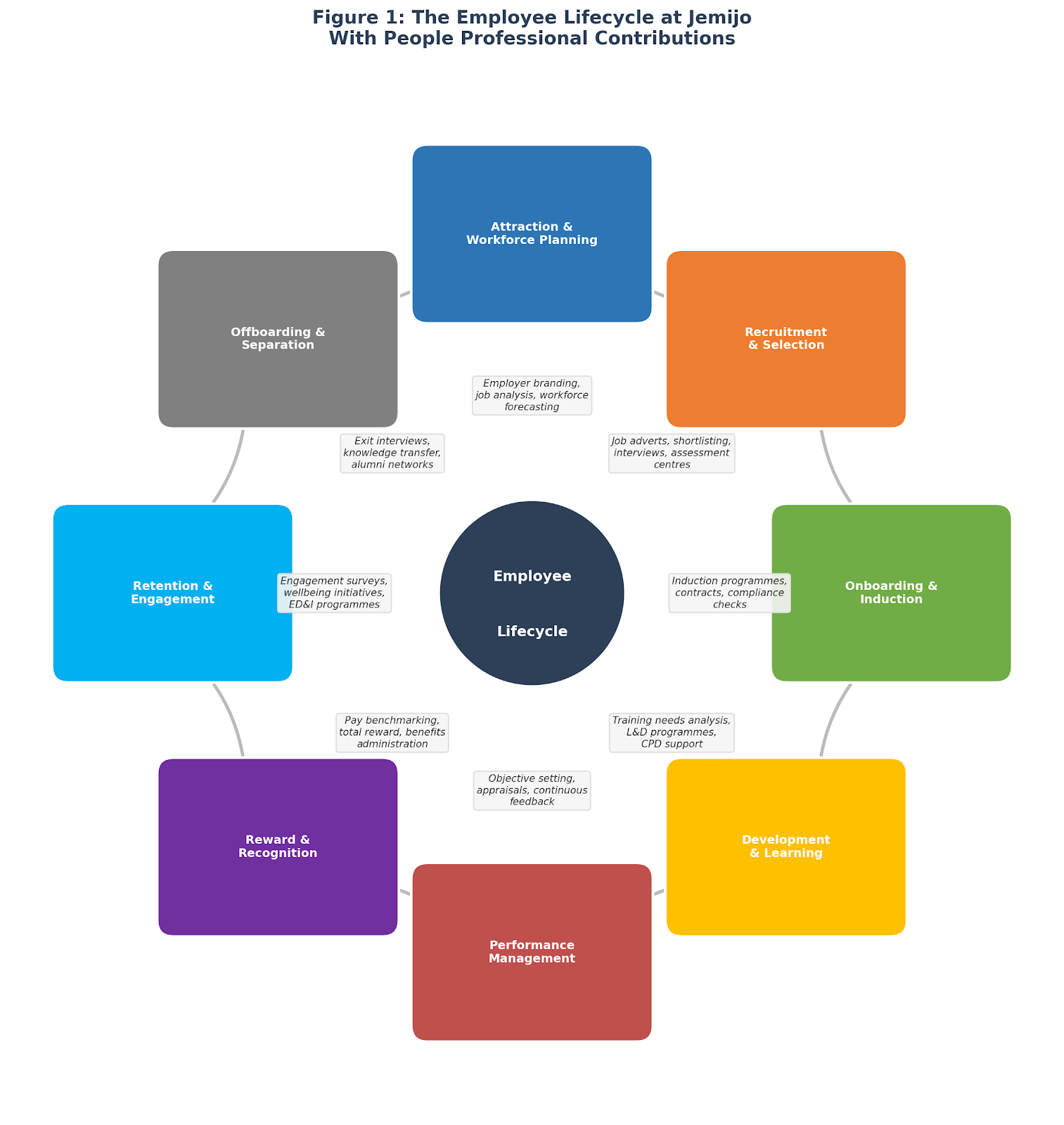
At the attraction and workforce planning stage, people professionals at Jemijo contribute by developing an appealing employer brand, conducting workforce planning to forecast staffing needs for the 24/7 claims hotline, and conducting job analysis to ensure role requirements are accurately defined. During recruitment and selection, the people team drafts compelling job advertisements, manages applications through the company website and external job boards, designs structured interviews and assessment centres, and ensures shortlisting processes are fair and legally compliant (Taylor, 2022).
At the onboarding and induction stage, people professionals prepare contracts of employment, coordinate the six-week basic training programme for new call centre staff, and ensure all compliance documentation is completed. During the development and learning phase, the team identifies training needs beyond the basic programme, designs learning interventions, and supports continuous professional development. In the performance management stage, people professionals support objective-setting, facilitate appraisal processes, and advise managers on performance improvement approaches (Armstrong and Taylor, 2023).